
Company News
From 400 m² to 3,000 m²: Eleven Years of Mixer Manufacturing at Ruijing
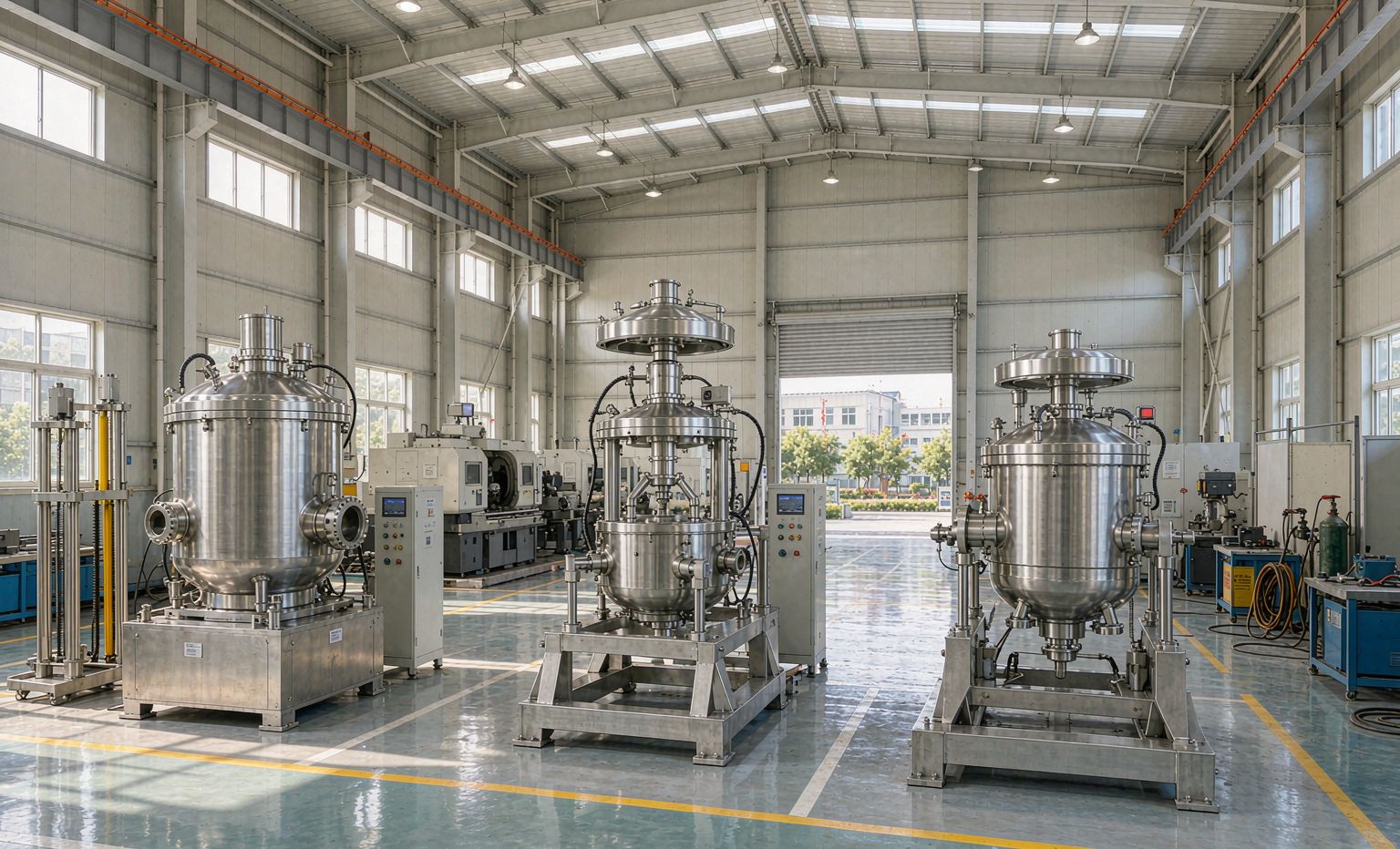
Ruijing Automation was registered in April 2015 in a 400 m² rented workshop in Dongguan. Eleven years later the company works from a 3,000 m² plant in Nanya Village, Daojiao Town, building planetary vacuum mixers, high-shear dispersers and the discharge presses that empty them.
Floor area is a crude metric, and it is not the one we would choose to lead with. But for a company that machines its own vessels rather than buying them in, square metres track capability fairly closely: every expansion was driven by a machine that would not fit in the old building, not by headcount.
1. Three buildings in eleven years
- April 2015 — company founded, first workshop of 400 m², focused on non-standard automation for adhesive and new-energy customers.
- Second move — 750 m², as vessel fabrication and assembly were brought in-house instead of subcontracted.
- November 2017 — recognised as a national high-tech enterprise.
- 2018 — CE certification for export, and registration of the Ruijing Hong and RuiJingHong trademarks.
- Current plant — 3,000 m² in Daojiao, covering machining, vessel work, assembly and electrical build under one roof.
2. What 3,000 m² actually buys
The plant runs its own machining and fabrication rather than outsourcing the parts that decide whether a mixer works. That matters most in three places: the vessel bore, which has to be machined so the scraper arm can wipe the wall clean on every revolution; the blade castings, which are die-cast in one piece so there is no weld seam to distort the profile; and the frame, which carries a lifting column and, on the larger sizes, a hydraulic power unit.
Standardised process documentation sits on top of that. Every unit is assembled, wired and run before it leaves — vacuum decay, temperature loop, lift stroke, discharge — so that a factory acceptance test is a record of the actual machine rather than a template.
3. The product line today
Six families, from a 0.2 L benchtop unit to a 1,000 L frame:
| Family | Range | Role |
|---|---|---|
| Laboratory planetary vacuum mixer | 0.2 – 10 L | Formulation screening on production-like kinematics |
| Planetary vacuum mixer | 2 – 1,000 L | High-solids paste under vacuum; single or dual planetary arms |
| Multi-function / high-shear disperser | 120 – 500 L | Emulsifying, wetting and dispersion of lower-viscosity systems |
| Integrated mixer-discharge unit | 2 – 20 L | Mix and press out of the same vessel, no transfer |
| Discharge press | 200 L / 300 L | Emptying and portioning high-viscosity compound from a mixer vessel |
| Vacuum kneader | 50 L | Heavy-duty kneading of putty-like, low-flow materials |
Also built: vacuum ovens, industrial ovens, non-standard machinery and industrial control cabinets.
4. What has not changed
The mixing principle is the same as it was in the first 400 m²: two blades orbiting the vessel while rotating on their own axes, a scraper that follows the wall, and a vacuum-tight lid. What has changed is the range over which that principle is repeated without redesign — the same blade geometry and wall-scraper relationship now appears at 2 L and at 1,000 L, which is what allows a formulation tested in the laboratory to be produced at scale without a second round of process development.
Planning a line that mixes and discharges in one vessel?
Tell us your batch size, viscosity and discharge format. We will map it to a standard frame or quote a non-standard build, with the utility requirements and FAT protocol included. Talk to the application team ›
Direct Factory Engineering
Inquire About RJ-VPM Series
Need custom pilot trials or gigafactory scale quotation? Speak directly with our mixing engineers.