
 BENCHTOP / R&D
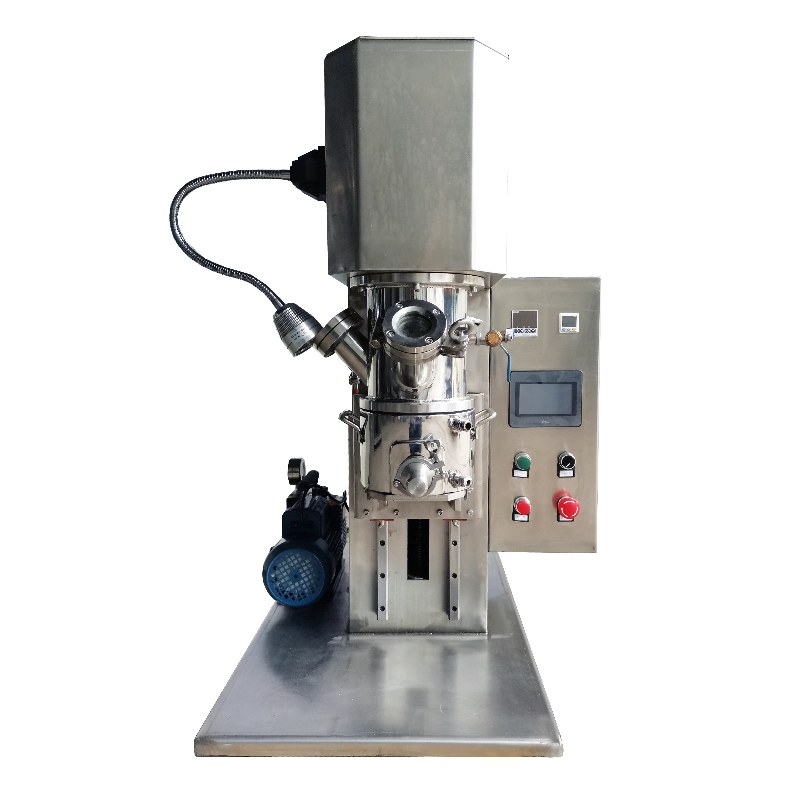
0.2-1 L Laboratory Planetary Vacuum Mixer
MODEL: RJ-JBC-L-0.2/1L // CE CERTIFIED
A benchtop planetary vacuum mixer range covering 0.2 L, 0.3 L, 0.5 L and 1 L vessels — built for gram-scale formulation screening of conductive adhesives, electronic pastes and battery slurries on the same mixing kinematics as the production frames. Change the vessel, keep the recipe.
Technical Specifications
Four vessel sizes on one bench frame: 0.2 L, 0.3 L, 0.5 L and 1 L, for gram-scale screening.
| Parameter | Specification Value | Engineering Notes |
|---|---|---|
| Design Volume | 0.2 - 1 L | 0.2 / 0.3 / 0.5 / 1 L vessels |
| Stirrer Motor | 200 W @ 150 rpm | No separate disperser shaft |
| Footprint | 500 × 470 × 688 mm | Benchtop frame |
| Machine Weight | 200 kg | Cast base, lifting column |
| Power Supply | 220 V, single phase | Standard laboratory supply |
| Vacuum Instrumentation | Panasonic digital vacuum gauge | Standard on all models |
| Temperature Sensing | PT100 sensor, product contact | Standard on all models |
| Blade Construction | Single-piece die-cast twist blade, weld-free | Folding version optional |
| Discharge | Vessel lifted out | No discharge port at this size |
| Control System | Touch-screen HMI + PLC | Recipe storage and repeatable ramp |
Key Design Features
A 200 kg benchtop machine that still behaves like the production vessel it is meant to predict.
Planetary Action at 0.3 Litres
Two arms orbit while rotating on their own axes, with the scraper following the wall. At this size the batch is measured in grams, but the kinematics are those of the production frames, so a screening result transfers.
Stirrer Only, 200 W at 150 rpm
A separate high-speed shaft on a 0.3 L vessel would be over-specified: the disc diameter is so small that tip speed falls away and the shaft adds cleaning work. The 0.2 L frame is a stirred, vacuum-tight mixer for screening.
Panasonic Gauge and PT100
Air removal is the point of screening conductive adhesives and pastes, so the machine carries the same vacuum gauge and product-temperature sensor as the production frames.
500 × 470 mm, 220 V Single Phase
The frame fits a fume hood or a laboratory bench and runs on a standard single-phase supply, so no installation work is needed before the first trial.
Where the 0.2 L Frame Fits
Screening, not production: the frame exists to fail cheaply before a formula reaches a larger vessel.
Formulation Screening
Comparing filler loadings, wetting agents or mixing sequences on 200–300 mL batches before committing material to a pilot run.
Conductive Adhesive
Checking whether a silver-filled adhesive deaerates cleanly under vacuum at a given solids loading.
Electronic Paste
Small-batch homogenisation of thermal or electronic pastes where a few hundred grams is the entire sample budget.
Customer Samples
Producing a reproducible sample set from a single reference batch for qualification testing.
Frequently Asked Questions — RJ-VPM-500L
Common engineering inquiries regarding vacuum retention, viscous material discharge, cleanroom compliance, and global FAT sign-off.
Q1. Why does this model have no high-speed disperser?
At 0.3 L the disc diameter is too small for a separate disperser to add useful tip speed, and the extra shaft would only add cleaning work between samples. The frame is a stirred vacuum mixer for screening formulations, not a scale model of a dispersing machine.
Q2. Can it run under vacuum like the production mixers?
Yes. The vessel is sealed and the machine carries a Panasonic digital vacuum gauge plus a PT100 sensor in the product, which is what makes it useful for screening adhesives and pastes where air entrapment is the failure mode.
Q3. How is the batch emptied?
There is no discharge port at this size. The vessel is lifted out of the frame and the batch is transferred manually or with a small press-out unit.