 THREE-SHAFT
300 L Three-Shaft Vacuum Mixer
CE CERTIFIED
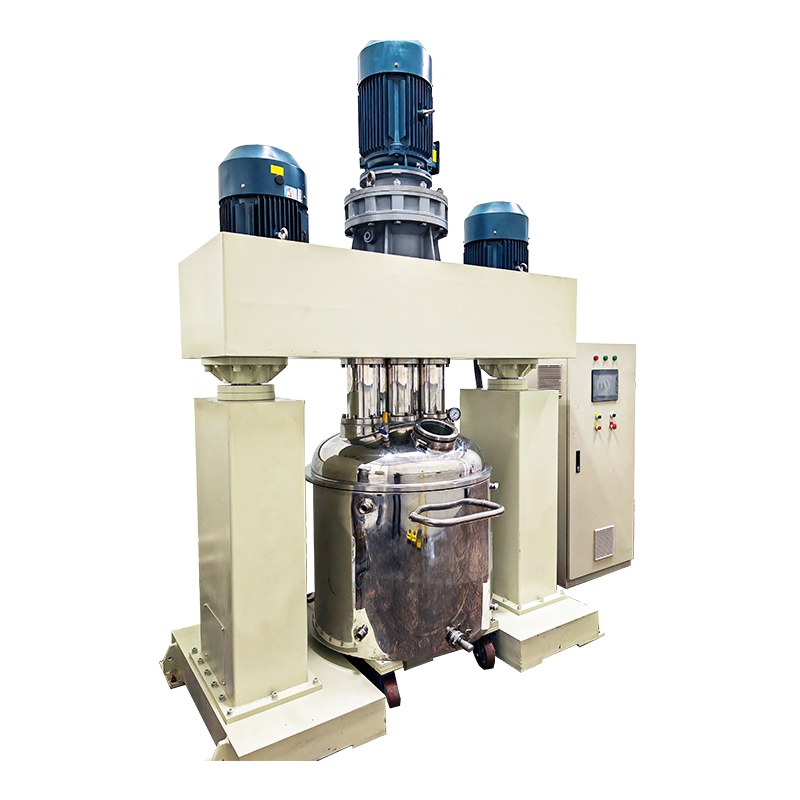
A 300-liter three-shaft planetary vacuum mixer with two folding arms and two independently driven high-speed dispersing discs, a wall scraper running with the carrier and a machined vessel bore — for high-solids pastes that need shear and kneading at once.
Technical Specifications
A 300-liter three-shaft planetary vacuum mixer: two low-speed planetary arms for folding and two independently driven high-speed dispersing discs for shear, all orbiting the same vessel.
| Parameter | Specification Value | Engineering Notes |
|---|---|---|
| Working Volume | 300 L | Vacuum vessel, machined bore |
| Planetary Shafts | 2 blades, fixed rotation ratio | Orbit plus own-axis rotation, reversible |
| Dispersing Shafts | 2 independent drives | High-speed toothed discs, VFD each |
| Wall Scraper | Rotates with the planetary carrier | Scrapes wall and bottom continuously |
| Vessel Heating | Electric / steam / oil-water circulation | Jacket coil for cooling |
| Bore Finish | Vertical lathe machined | Scraper clears wall and bottom fully |
| Operation | Vacuum | Sealed vessel, air removed during mixing |
Key Design Features
Four shafts in one vessel: two that fold the paste and two that shear it, each on its own drive.
Two Planetary, Two Dispersing
Two parallel blades orbit the vessel at a fixed rotation ratio while rotating fast on their own axes; two separately driven toothed discs orbit with them. Shear and kneading happen at the same time instead of in sequence.
VFD on Each Disc
The dispersing discs are variable-frequency driven, so tip speed is set by the process rather than by the planetary ratio. That is what allows one frame to run both a low-shear fold and a high-shear dispersion step.
No Static Film on the Wall
The frame-mounted scraper turns with the carrier and clears wall and bottom, and the bore is machined on a large vertical lathe so the clearance stays constant around the circumference.
Electric, Steam or Oil-Water
The jacket accepts electric heating, steam or oil-water circulation, with a coil for cooling. Vacuum mixing under a sealed lid removes the air the folding action would otherwise bury.
Where the 300 L Three-Shaft Frame Fits
High-viscosity systems that need both folding and high-shear dispersion in the same batch.
Battery Slurry
Anode and cathode mixes where conductive additive agglomerates have to be broken down inside a high-solids paste.
Conductive Adhesive
Silver-filled systems where the filler must be wetted and dispersed without being milled finer.
Sealants
Highly filled compounds that need folding by the planetary arms and shear from the discs.
Electronic Paste
Pastes where dispersion and temperature history both have to be repeatable batch to batch.
Frequently Asked Questions — RJ-VPM-500L
Common engineering inquiries regarding vacuum retention, viscous material discharge, cleanroom compliance, and global FAT sign-off.
Q1. What do the four shafts do that a two-shaft mixer cannot?
Two shafts fold the paste and two shear it, each on its own drive. That means dispersion and kneading run simultaneously at their own speeds instead of compromising on one shaft speed for both.
Q2. Can the planetary arms reverse?
Yes. The stirrer direction can run with or against the planetary rotation, which changes the shear pattern in the vessel — a feature carried over from the old-site description of the reversible-rotation model.
Q3. How is the wall kept clean?
A scraper running with the planetary carrier clears wall and bottom, and the vessel bore is machined on a large vertical lathe so the clearance is uniform all round.
Related Processing Equipment
500 L Three-Shaft Vacuum Disperser
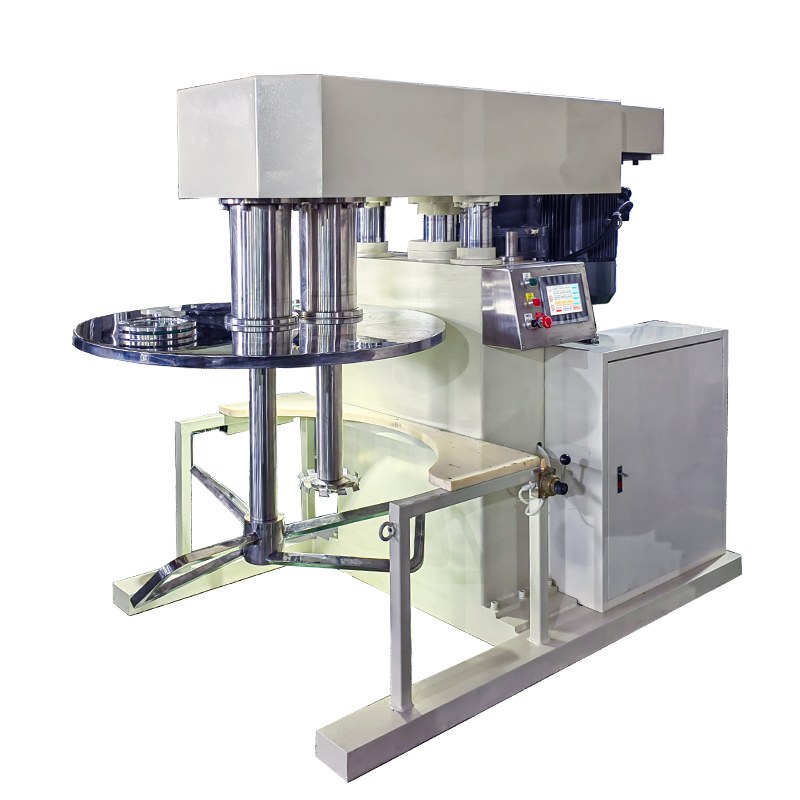
A 500-liter three-shaft planetary vacuum disperser with two folding arms and two independently driven high-speed dispersing discs, a wall scraper running with the carrier and a machined vessel bore — for high-solids pastes that need shear and kneading at once.